The Bedrock of the Musselshell: Geologic Significance
The stone sourced around Harlowton is primarily harvested from the Judith River Formation, often found in transition with the underlying Clagett Formation. Dating back approximately 75 to 80 million years to the Upper Cretaceous, these layers were formed as the Western Interior Seaway retreated, leaving behind a complex system of ancient coastal plains and river deltas.
Why the Judith River Formation is a Mason’s Goldmine
Not all sandstone is created equal. The Judith River Formation is prized by quarrymen and architects alike because of three specific geologic traits:
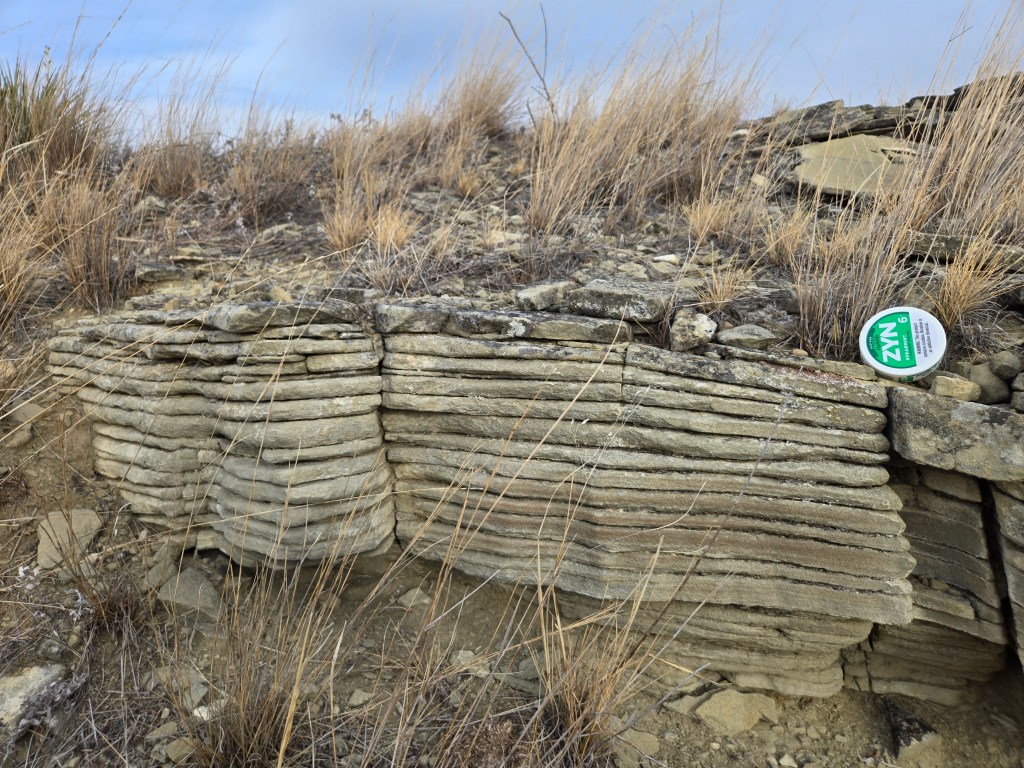
- Variable Thickness Bedding: The formation features diverse “lifts” or layers. This allows for the extraction of everything from 2-inch thin flagging to massive 12-inch “jumper” blocks. This natural variety ensures that a mason can create a diverse, random-ashlar pattern without needing to heavily process the stone.
- Superior Cementation: Thanks to millions of years of mineral-rich groundwater movement, the sand grains are tightly bound by silica and calcium carbonate. This high level of cementation means the stone is less porous, highly resistant to the “spalling” (flaking) caused by Montana’s freeze-thaw cycles, and maintains its structural integrity when cut.
- Exquisite Natural Cleft Textures: Because the stone splits predictably along its horizontal bedding planes, it reveals a “natural cleft” surface. This texture is rugged yet flat enough for flooring and hearths, providing an authentic, non-slip finish that showcases the internal character of the ancient river sediments.
A Legacy in Layers: Historic Applications
In 1907, a devastating fire swept through Harlowton’s business district. In the aftermath, the city required fireproof construction, turning Harlowton into a “Sandstone City.”
The Graves Hotel
The most iconic example is the Graves Hotel, built in 1908. Local stonemasons didn’t have to look far; they quarried the Judith River sandstone from the nearby rims. The massive, hand-cut blocks are a testament to the skill of early 20th-century masons who turned the local cliffside into a three-story landmark that still stands today as a monument to local geology.
Modern Masonry: From Harlowton to the World
Today, the tradition of Harlowton stone is more vibrant than ever. What was once a local necessity is now a high-end architectural staple exported across North America.
Current Applications:
- Architectural Veneer: Modern technology allows this dense sandstone to be sawn into thin veneer. This provides the “castle-wall” look of the Graves Hotel but with a weight profile that can be applied to modern timber-frame or steel buildings.
- Dimensional Stone: Because of its excellent cementation, the stone can be fabricated into custom lintels, sills, and heavy hearths that serve as the focal point of high-end mountain homes.
- Structural Landscape: The variable bedding makes it the gold standard for “stand-up” flagstone and heavy outcropping stone, allowing landscape architects to mimic the natural rimrocks found throughout Wheatland County.
The stone of Harlowton is a rare material that manages to feel both ancient and contemporary. It is a piece of the Montana landscape, literally pulled from the earth to provide a sense of permanence and grit.
The Depositional Environment: Building a Masterpiece
To understand why this stone performs so well today, we have to look back 75 million years to the Late Cretaceous. At that time, Harlowton sat on the western edge of the Western Interior Seaway, a massive inland sea that split North America in two.
The Judith River Formation was deposited in a prograding deltaic and alluvial environment. As the sea retreated (a process called regression), massive river systems flowed eastward from the rising mountains, carrying immense loads of sand and silt. These were deposited in wide floodplains, estuaries, and coastal marshes.
Geologic Traits of a Superior Masonry Stone
This specific “transitional” environment—where land met sea—gifted the Judith River sandstone with the structural traits that masons prize today:
- High-Energy Sorting: The river systems that formed these beds were powerful enough to “sort” the sediment. They washed away finer clays and silts, leaving behind clean, uniform quartz and feldspar sands. This results in a stone that is consistent in its grain and less prone to “mud seams” that can cause stones to crack or fail.
- Episodic Deposition (The Layering Secret): The formation was built through distinct pulses of sediment. Periods of heavy flooding deposited thick layers of sand, followed by quieter periods that created thin “parting planes.” This is what gives the stone its variable thickness bedding, allowing modern quarrymen to find everything from thin patio pavers to massive structural blocks in the same face.
- Secondary Mineralization: As the sediments were buried, mineral-rich fluids (silica and calcium) circulated through the pore spaces. This “secondary cementation” acted like a natural grout, locking the sand grains into a dense, crystalline matrix. This provides the high compressive strength necessary for the heavy load-bearing blocks seen in historic Harlowton architecture.
- Tectonic Compression: Being in the shadow of the rising Rockies, these formations underwent subtle tectonic squeezing. This pressure helped “pre-stress” the stone, contributing to the clean natural cleft—the tendency of the stone to snap in straight, crisp lines when struck by a mason’s hammer.
 theslab.blog
Leave a comment